Dynamic Transparency: Target-Driven Occluder Transparency

The Dynamic Transparency system was implemented to improve player visibility when a shared camera becomes blocked by walls or other large environment objects.
The implementation is inspired by the Dynamic Transparency technique described by Elmqvist, Assarsson and Tsigas, where occluding geometry is selectively made transparent around important targets instead of fading the entire object.
The main goal is simple:
If a player is hidden behind an eligible occluder, only the region of that occluder around the player becomes transparent.
This preserves most of the environment visually while keeping the player readable at all times.
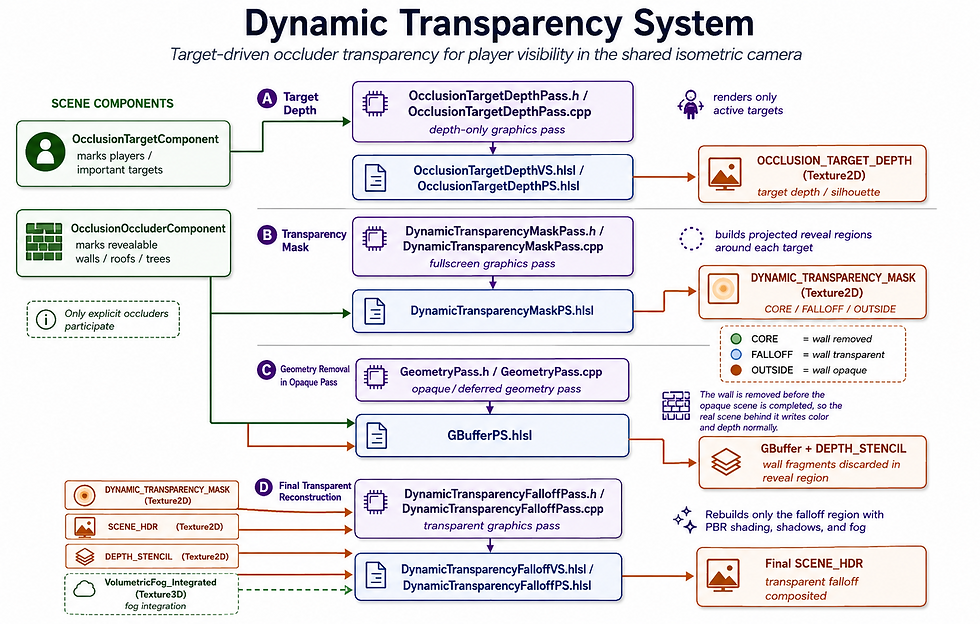
1. Targets and Occluders
The system introduces two new scene components.
OcclusionTargetComponent marks objects that should remain visible, normally the players.
It exposes two parameters:
Falloff Scale — controls the size of the transparency region.
Falloff Softness — controls how gradually the transparency transitions back to the opaque wall.

OcclusionOccluderComponent marks environment geometry that is allowed to participate in Dynamic Transparency.

This distinction is important because only explicitly tagged occluders are affected. Other objects between the camera and the player continue behaving normally.
Camera
  ↓
Wall        ← OcclusionOccluder
  ↓
Column      ← normal geometry
  ↓
Player      ← OcclusionTarget
The wall may become transparent, but the column can still occlude the player normally.
2. Occlusion Target Depth
The first dedicated render pass, OcclusionTargetDepthPass, renders only active occlusion targets into a separate depth texture.
This depth buffer is independent from the normal scene depth and therefore keeps track of where the players are on screen even when they are hidden behind environment geometry.
It provides the information required to determine whether an occluder fragment is actually in front of a target.
3. Dynamic Transparency Mask
DynamicTransparencyMaskPass combines the target depth with the projected bounds of each target to create a screen-space transparency influence.
Conceptually, the resulting region contains three areas:

The exact target silhouette forms the CORE, ensuring that the player remains fully visible.
A larger region around it forms the FALLOFF, producing a smooth transition between the clear area and the original opaque wall.
The mask does not contain the wall itself. It only describes where and how strongly an eligible occluder should become transparent.
4. Removing the Occluder from the Opaque Scene
Dynamic Transparency is integrated directly into the existing GeometryPass.
When an OcclusionOccluder is rendered, its fragments are compared against the transparency mask and target depth.
Eligible wall fragments that are inside the reveal region and in front of a player are removed from the opaque pass.
Because those fragments no longer write color or depth, the real scene behind the wall renders normally.
This is an important difference from simply drawing the player on top of the environment: objects behind the wall still preserve their normal depth relationships.
5. Transparent Falloff Reconstruction
Once the opaque scene has been rendered, DynamicTransparencyFalloffPass renders the occluder geometry again.
This time, only wall fragments whose screen-space positions fall inside the FALLOFF region are kept and blended transparently with the already rendered scene.
The final behaviour is therefore:

The transparent falloff keeps the original wall material and integrates with the existing PBR lighting, shadows and volumetric fog, helping the transition remain visually consistent with the rest of the environment.
6. Multiple Targets and Occluders

The system supports both players independently.
Each target keeps its own transparency influence and depth information, allowing overlapping transparency regions to be evaluated correctly.
Multiple transparent occluders are also composed back-to-front to preserve the expected transparency result when several eligible objects overlap.
Final Result

The result is a selective visibility system where players remain readable without making entire walls disappear.
Only explicitly marked environment geometry participates, the player silhouette remains completely clear, the surrounding wall fades progressively, and normal scene objects continue preserving their original depth and occlusion behaviour.
It also provides a flexible foundation for future improvements such as more advanced occluder selection, better handling of very close target/occluder intersections, or additional transparency shapes.


Comments